When Every Idol Is an Ambassador
What Makes a Luxury Partnership Actually Believable?
By Adeleine Wang - Growth Marketing Strategist & Brand Observer
Prologue: Seoul, the Front Row, and a Changing Order
The front row, once the most quietly hierarchical space in fashion, has been redrawn. Paris and Milan still hold the runways, of course. Couture week still belongs to the rue Cambon and the Avenue Montaigne. But the attention layer, that delicate, almost invisible architecture of who is photographed, who is reposted, whose presence makes a collection feel current, has shifted east. To be precise, to Seoul.
This is no longer a surprising observation. Karina arrives at Prada and a single appearance generates several million dollars in earned media value. Jennie’s outfit at a Chanel after-party becomes a global aesthetic reference within hours. Jisoo’s seat at the Dior show seems to anchor the entire evening’s social presence. K-pop idols have become, there is really no other way to put it, one of luxury fashion’s most powerful visibility engines.
And yet, precisely because of this, the K-pop ambassador appointment is no longer impressive by default. Every season brings a new contract, a new beauty face, a new airport photograph in head-to-toe Maison X. The market is no longer saturated with idols. It is saturated with weak narratives.
This essay is an attempt to ask a more useful question. Not who is the most popular, nor who is most photogenic, but: which partnerships actually feel as though they belong? When does an ambassadorship become a believable extension of a house, rather than merely a contract written in flattering light?
From Endorsement to Translation
In an earlier era, luxury ambassadors were largely decorative. A Hollywood actress was retained because she made the brand look glamorous; the relationship was lit, photographed, and politely returned. The contract was, in essence, an act of mutual flattery.
What K-pop idols do is rather different. They translate.
When Jisoo wears Lady Dior, she is not simply being beautiful in a beautiful bag. She is teaching a younger, very global audience how to read Dior’s heritage femininity, what it feels like, what kind of woman it imagines, what register of glamour it occupies. When Karina appears in Prada, she is not modelling clothes; she is making Prada’s intellectual, slightly detached coolness legible to a Gen Z audience who otherwise might not know how to enter it.
This is why K-pop’s effect on luxury cannot be reduced to a numbers conversation. Yes, the EMV figures are extraordinary; yes, conversion rates on a single Wonyoung carousel can move stock. But the deeper consequence is that idols have become the interpreters of maison codes for a generation that no longer learns about luxury from the September issue.
The strongest example, still, is BLACKPINK. The group’s commercial power was always read in aggregate, but the actual genius of their luxury strategy was that each member became a distinct dialect of luxury. Jennie spoke Chanel: cool, modern, slightly aloof. Jisoo spoke Dior: soft, heritage, classically feminine. Rosé spoke Saint Laurent: emotional, minimal, slightly melancholy. Lisa spoke Louis Vuitton and Bvlgari: sharp, performative, internationally maximalist. Four members, four luxury languages, with almost no overlap. It is the cleanest demonstration of brand architecture in modern celebrity culture, and nearly every K-pop agency that has followed has tried to reproduce its discipline.
The Saturation Problem
But the very success of this model has produced its current crisis. If every group has an ambassador roster, and every member has a maison, the appointment itself becomes a kind of background noise. A new ambassador announcement now generates the same fatigue as a new fashion collaboration: one watches it pass, files it away, and waits for something that actually means something.
There are, broadly, three failure modes.
The first is visibility without memory. A campaign is launched, a carousel is posted, the engagement is excellent, and yet six months later no one can remember what the campaign was actually selling. The idol was famous; the product was not made desirable. This is the most expensive form of forgettable success.
The second is persona mismatch. The idol is famous, the house is famous, and the pairing nevertheless feels slightly off, as though the codes never quite agreed to sit at the same table. One sees this often in pairings that look correct on paper but never produce a single iconic image.
The third is short-term media value without long-term equity. The numbers, in the immediate window, are excellent. But the relationship never accumulates into a story. It does not become a chapter in either the idol’s identity or the maison’s history. When the contract ends, there is nothing left behind.
Vogue Business has spent the last two years tracking this shift: brands are moving away from one-off, pay-to-post ambassadorial relationships and toward deeper, more strategic ones in which the talent functions almost as a creative collaborator. This is not a coincidence. It is the market quietly admitting that visibility alone has stopped working.
A Framework for What Actually Works
If one accepts that ambassador saturation is real, the next question is what distinguishes the partnerships that do hold. After a season of watching this carefully, and admittedly with considerable personal pleasure, six criteria seem to keep separating the believable from the merely visible.
1. Visual Fit. Does the idol’s face, silhouette, and personal style naturally carry the maison’s codes? Not in a forced way, but as if the wardrobe and the person had always been speaking.
2. Cultural Fit. What emotional or cultural register does the idol occupy - girlhood, elegance, futurism, melancholy, intimacy, rebellion - and does that register live inside the brand?
3. Product Fit. Can she make the product desirable, not just visible? Does the bag, the lipstick, the fragrance feel necessary after one sees her wearing it?
4. Narrative Fit. Is there a story the partnership keeps writing, season after season, that begins to belong to both of them?
5. Longevity. Can the relationship age? Will it survive a creative director change, a tour, a new album, a new chapter?
6. Market Translation. Can the ambassador open new geographies for the maison without flattening its identity?
Few partnerships score full marks on all six. The interesting ones tend to be those that score very high on the criteria most relevant to their particular moment.
“She does not interrupt the house’s language.”
Case Study: Jisoo x Dior - The Architecture of Continuity
It is rather difficult to write about Jisoo without slipping, briefly, into the register of admiration. There is something about her face - the soft jaw, the gentle distance in her eyes, the way her smile arrives with a half-second of restraint - that seems to belong to another decade entirely. She has a kind of beauty that does not date. Which is, in its way, the perfect qualification for the role she has been quietly perfecting since 2021.
Jisoo became a Dior global ambassador for fashion and beauty in March 2021, having joined Dior Beauty late the previous year. In the five years since, she has done what very few celebrity ambassadors achieve: she has accumulated. Each campaign is not a discrete event. Each appearance is a continuation. The Lady Dior, the Miss Dior, the Dior Addict - she has moved through the house’s most established icons, lending each of them a slightly younger, slightly softer emotional register without disturbing the heritage itself.
What is particularly interesting is what has happened in the past twelve months. Dior is, by any reasonable measure, in a moment of creative transition. Jonathan Anderson, after spending more than a decade rebuilding Loewe into one of the most quietly intelligent houses in luxury, has assumed creative direction. The AW26 show at the Jardin des Tuileries, staged inside a glass greenhouse, was his first full womenswear gesture - and Jisoo was on the front row, photographed approximately a thousand times, anchoring the social presence of the evening as though she had been there all along.
She had been there all along.
This is what longevity buys a maison: when the brand changes, the ambassador becomes the continuity. New artistic director, new silhouette, new mood - but the same face, the same emotional accent, the same audience that already knows how to feel about her. Jisoo, at this point, is less Dior’s ambassador than one of Dior’s characters. She is part of the house’s grammar.
Tested against the framework, the Jisoo x Dior partnership scores extraordinarily well. Visual fit: faultless - she inhabits Dior’s femininity as if it had been cut to her measurements. Cultural fit: she translates Dior’s heritage to a younger Asian audience without ever asking the house to simplify itself. Product fit: Lady Dior, Miss Dior, the Addict line, Dior Prestige - every category has been activated, and almost every category has shown lift. Narrative fit: there is now a five-year story, and it reads beautifully. Longevity: scarcely needs arguing. Market translation: she is genuinely one of the reasons Dior’s Asian growth has felt coherent rather than opportunistic.
If one wanted a single sentence to describe the partnership, it would be this: Jisoo works for Dior because she does not interrupt the house’s language. She softens it, modernises it, and makes its heritage feel emotionally accessible without ever pretending it is anything other than heritage.
That, it seems to me, is the rarest skill in luxury, and one wonders, looking at the AW26 photographs, whether anyone has done it quite as well in the past decade.
“Girlhood as aspiration, girlhood as project.”
Case Study: Wonyoung x Miu Miu - Curated Girlhood and the Question of Time
There is a particular quality of girlhood that Jang Wonyoung has made entirely her own. It is not innocence, exactly; it is not naivete. It is something more deliberate - a kind of polished, performed, almost art-directed girlhood. Hyper-feminine, hyper-disciplined, hyper-aware of the camera. Pink-bowed and lace-trimmed, but never accidentally so. It is girlhood as aspiration, girlhood as project, girlhood as a brand one wakes up at five in the morning to maintain.
It is also, as it turns out, the precise mood that Miu Miu has been quietly building since 2020.
Wonyoung was announced as a Miu Miu fashion ambassador in late 2021, in the December issue of Harper’s Bazaar Korea, when she was still only nineteen. The pairing made immediate sense: Miu Miu’s Gen Z-facing universe of pleated mini-skirts, librarian cardigans, and slightly absurd ballet flats had already begun to define what it meant to be young, intellectual, and decidedly feminine in 2020s luxury. Wonyoung brought to it an Asian fluency and an aspirational gloss that Miu Miu’s Western Gen Z audience had not, until then, fully possessed.
The numbers are quietly astonishing. At Paris Fashion Week Fall 2024, her appearances generated an estimated three million dollars in media impact value, ranking her thirteenth on Lefty’s list of top fashion week influencers. By 2024, her name had been mentioned over three billion times on Xiaohongshu - more than Lisa, Rosé, or Jisoo, and second only to Jennie. To put it in another register: in the most economically consequential luxury market in the world, Wonyoung had become one of the two most-discussed Korean idols, full stop.
In April 2026, Miu Miu deepened the relationship. Wonyoung was appointed Miu Miu Beauty ambassador for South Korea and Japan, fronting the campaign for Miutine, a new fragrance by Dominique Ropion that opens with wild strawberry and gardenia before settling on brown sugar, patchouli, and bourbon vanilla. The official statement described her as embodying “modern femininity and unapologetic individuality, resonating deeply with the free-spirited and unconventional essence of the house.” Translated from press-release into something more candid: she is the face that lets Miu Miu’s universe travel across the most important North Asian markets without losing its mood.
Wonyoung x Miu Miu scores beautifully on visual fit, cultural fit, product fit, and market translation. The longevity question, though, is genuinely interesting. Curated girlhood, by definition, has a horizon. If Dior gives Jisoo the language of elegance - a language that ages well - Miu Miu has given Wonyoung the language of girlhood, which is a more time-sensitive register. The challenge for the partnership is not whether Wonyoung fits the brand now. She clearly does. It is whether the partnership knows how to evolve when girlhood itself begins to age.
One suspects it will, because Miu Miu is rather clever about exactly this. The maison has been carefully expanding Wonyoung’s repertoire - fashion first, then jewellery via Fred and Bvlgari, now beauty and fragrance. Each category gives her a slightly older register to grow into. The bow does not have to be untied; it simply needs to learn new ways to be tied.
There is also, if one is being honest, something rather lovely about watching this strategy unfold in real time. Wonyoung is twenty-one. The partnership is still on its first chapter. The most interesting work is still ahead.
“A voice that already sounds like his Valentino.”
Case Study: Liz x Valentino - A New Voice for Michele’s Romantic Reverie
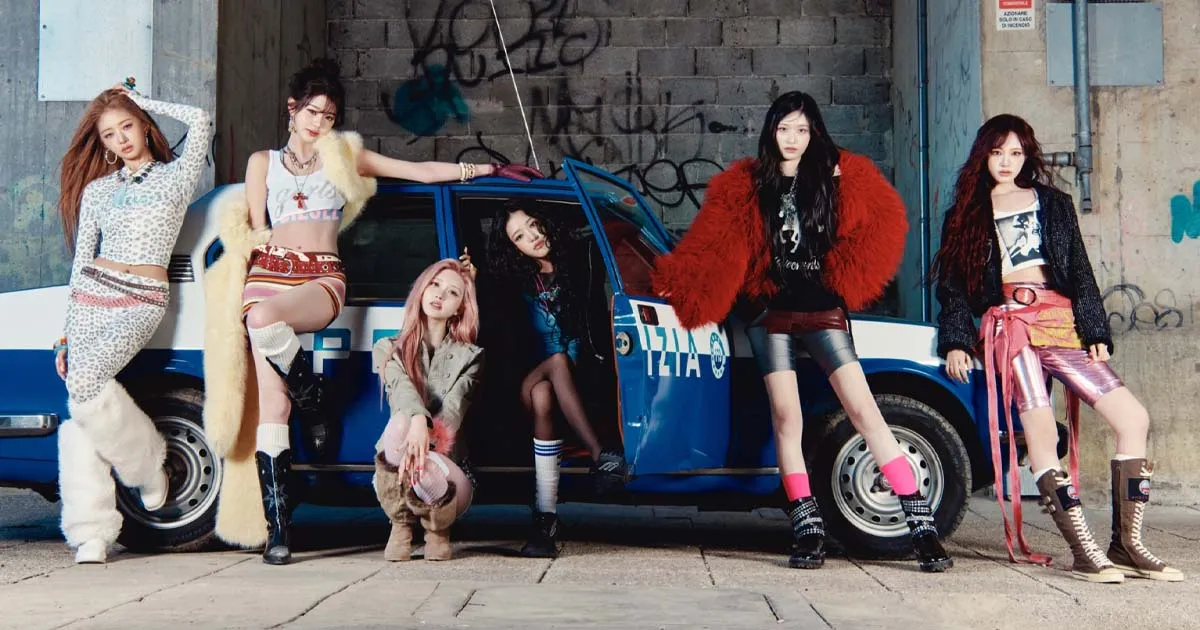
The most genuinely surprising appointment of early 2026 was not the loudest one. It was Valentino, in January, quietly announcing that IVE’s Liz and Rei would be joining the maison as global brand ambassadors, presented at the Specula Mundi Haute Couture S/S 2026 show in Paris. The two arrived at Charles de Gaulle in head-to-toe Valentino, walked into the show in pieces from the FireFlies collection, and - in a way that was difficult to articulate at first - belonged.
To understand why this pairing matters, one has to understand the context. Valentino is in the middle of a creative reinvention. Alessandro Michele, fresh from his decade-defining tenure at Gucci, has taken creative direction. His Valentino is unmistakably his: romantic, theatrical, archival, layered with a quiet melancholy, and committed to an interiority that fashion has not seen quite this clearly in some years. This is not the Valentino of Pierpaolo Piccioli’s high colour and glittering glamour. This is a more private, more strange, more bookish Valentino. It is a house being asked to remember its own poetry.
And then, into this newly poetic Valentino, walks Liz.
Liz is IVE’s main vocalist, and there is a reason she has been nicknamed the Tone Fairy. Her voice combines clarity with emotional depth; her performances tend to land softly and stay long after they have stopped. In September 2025, her appearance on Hangout with Yoo went genuinely viral, in part because the production crew were visibly stunned by what she did - a rare moment where a broadcast setting could not quite contain the performance. She is the kind of singer who makes you stop what you are doing.
The fit with Michele’s Valentino, when one really thinks about it, is rather extraordinary. Michele is a designer of interiority - of the soft, the layered, the slightly melancholic, the romantically literary. Liz’s voice has the same quality: clarity wrapped in feeling, technique softened by sincerity. She does not have the cool detachment of a Karina or the polished girlhood of a Wonyoung. Her register is something quieter - emotional, observed, almost diaristic. It is precisely the register Michele’s Valentino is trying to revive.
Visually, too, it works. Liz has a face that photographs slightly sadly even when she is smiling, which is exactly the quality the best of Michele’s casting has always exploited. There is a softness in her, but also a privacy - the sense that the most interesting things about her are happening one layer down. Michele’s Valentino does not need ambassadors who arrive shouting. It needs ambassadors who arrive whispering. Liz, in this sense, is almost too well chosen.
The partnership is still very young, barely a season old, and one must be careful not to overstate on the basis of a single appointment. But the framework does hint strongly at its potential. Visual fit: high, in a quiet way. Cultural fit: extraordinary, because she carries the emotional register Michele needs. Product fit: as yet undetermined, but Valentino’s beauty and accessories portfolio offers plenty of room to grow. Narrative fit: this is where it becomes most interesting - Liz has the chance to become the face of Michele-era Valentino in Asia, which is a meaningful piece of luxury history to write. Longevity: high potential, contingent on both Liz’s career and Michele’s tenure. Market translation: significant, especially given IVE’s vast and rapidly growing global fandom.
If one is permitted a small note of personal feeling: this is the partnership one watches most closely for the next eighteen months. It is the rare appointment that feels less like a strategy and more like a discovery. Michele has, in Liz, found a voice that already sounds like his Valentino, and Liz has, in Michele, found a maison that already understands how she sings.
A Brief Word on the Rest
Two further partnerships deserve a passing observation.
Jennie x Chanel remains the case study every luxury marketer should study quietly. Jennie became a Chanel Beauty face in 2017 and a Chanel global ambassador in 2019; by 2026, the partnership is nearly nine years old. What is striking is how completely she has been absorbed into Chanel’s modern mythology - she is no longer merely Chanel’s ambassador; she is part of Chanel’s contemporary self-image. Longevity, once again, turns an ambassador from a media asset into a brand character.
NewJeans, by contrast, illustrates the opposite risk. The group’s collective mood - Y2K nostalgia, casual intimacy, low-pressure girlhood - was always its greatest cultural asset. But luxury ambassadorship tends to operate by isolation: it likes to take one member, give her a house, and let her develop alone. As NewJeans members have been distributed across different maisons, the collective mood has fragmented. This is not necessarily a failure, but it is a warning. Luxury brands love individual faces. K-pop power often begins with collective emotional identity. The two impulses do not always cooperate.
What Luxury Should Learn
If there is a single lesson to draw from looking at this carefully, it is that ambassador saturation does not mean luxury houses should stop working with K-pop. Quite the opposite, in fact: K-pop has proven, over the past five years, to be one of the most powerful cultural translators luxury has ever had access to. The lesson is rather about how.
The successful partnerships - Jisoo x Dior, Jennie x Chanel, Wonyoung x Miu Miu, Liz x Valentino, and a small handful of others - share something that ordinary partnerships lack. They are designed for fit before they are designed for reach. They imagine the relationship in seasons, not weeks. They allow the ambassador to age into the brand. They write a story, rather than schedule a moment.
Luxury houses entering the K-pop ambassador market in 2026 should perhaps stop asking who has the biggest fandom. The more useful questions are quieter ones.
What brand code does this person naturally carry?
What product can she actually make desirable, rather than merely visible?
What cultural emotion does she translate - and is it the emotion this house is in the business of selling?
Can the relationship survive a creative director change, a tour, an album cycle, a chapter break?
When the campaign is over, will the audience remember the story, or only the headline?
The most powerful luxury ambassador is not the idol who simply wears the brand best. She is the one who makes the brand feel as though it had been waiting for her all along.
Coda: From Attention to Belief
K-pop has already done what no marketing department could have arranged. It has changed the cultural temperature of luxury. The front row, the airport photograph, the campaign, the post - these are now mediated through Seoul as much as through Paris. The visibility battle is, in essence, over. Luxury will be looked at, and K-pop will be how it is looked at.
The next contest is more subtle. It is a contest for belief. In a market this saturated, the partnerships that will matter are the ones that feel inevitable, the ones in which the idol and the maison appear, by some quiet alchemy, to have always belonged together. Jisoo at Dior, settling into a fifth year. Wonyoung at Miu Miu, growing into a bigger version of herself. Liz at Valentino, whispering. Jennie at Chanel, holding the architecture of a decade.
In luxury, attention has always been expensive.
What is rare now is belief.
And the most beautiful partnerships, one rather suspects, will be the ones that quietly produce it.
Adeleine - May 2026
Filed under: Brand Strategy · Cultural Marketing · Luxury & Gen Z