
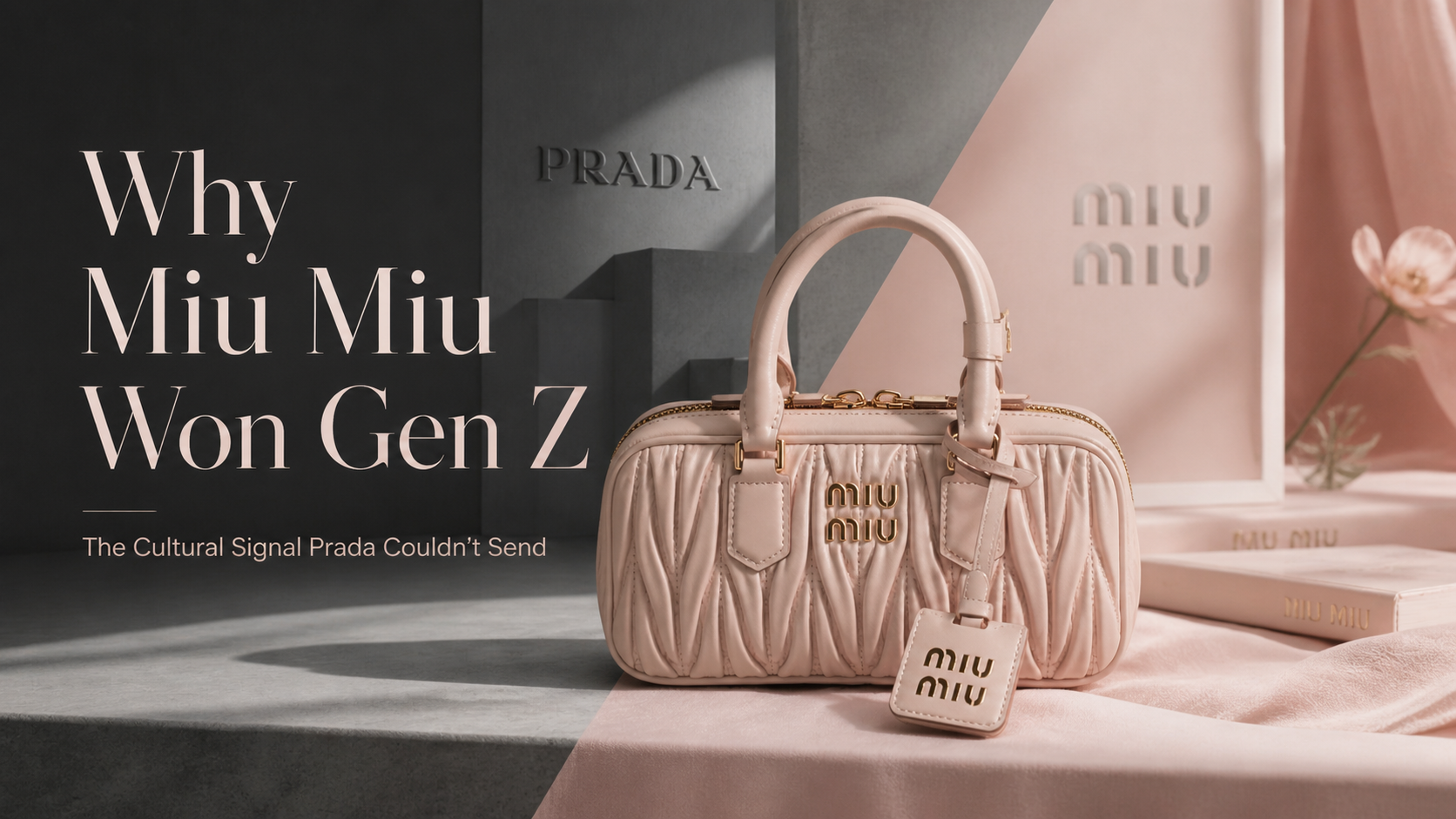
Why Miu Miu Won Gen Z
The Cultural Signal Prada Couldn’t Send
By Adeleine Wang - Growth Marketing Strategist & Brand Observer
Miu Miu did not simply become popular because it was younger, sexier, or more viral. It won because it gave Gen Z a luxury language that felt intelligent, imperfect, emotional, and alive.
Picture her, briefly. A young woman crossing a courtyard somewhere in Paris, Seoul or Brooklyn - the geography hardly matters now; the silhouette has gone borderless. Her skirt is pleated and improbably short. Her cardigan is two sizes too large, the cashmere fraying at one cuff in a way that reads as both careless and deliberate. She wears loafers, scuffed at the toe; tortoiseshell glasses she may not actually require; a leather bag that looks as though it has read more books than most of its admirers. Her hair is undone in the manner that only a great deal of consideration can produce.
She is not exactly dressed. She is, more accurately, legible.
That is the central insight of Miu Miu’s ascent. The brand has not sold Gen Z a wardrobe. It has sold them a readable self - a small, portable identity one can step into in the morning and step back out of in the evening, having performed something like intelligence, irony, sensuality and unfinished youth, all at once. Prada, the elder house under the same family hand, has continued to do something equally precise but altogether less emotional: it has sold the quiet, well-made conviction that one need not be read at all.
The two houses are not in competition with each other. They are in conversation. And it is the difference between what each of them is willing to say that explains why one of them - the younger, smaller, less institutionally serious one - has become the loudest cultural signal in luxury this decade.
Prada’s Emotional Alter Ego
It has become fashionable, in the trade press, to describe Miu Miu as a kind of younger sister to Prada - a softer, more playful version of the mothership. The framing is not wrong, exactly, but it is far too genealogical. Sisters share a household; they do not necessarily share a worldview.
Prada’s worldview, refined across decades, is one of intellectual authority. Its tailoring is architectural; its references - the nylon, the triangle, the suppressed prints, the slightly austere woman walking briskly past a cement wall - are deliberately cerebral. Prada has always understood luxury as a form of editorial restraint. A Prada garment does not flatter you; it accompanies you, in the manner of a clever, slightly aloof friend who takes notes during dinner.
Miu Miu’s worldview is something else entirely. It is not Prada-lite, nor Prada-young. It is Prada’s emotional alter ego - the part of the same intelligence that is permitted to be girlish, ironic, anxious, sensual and self-aware in public. Where Prada says, without condescension, I understand taste, and I will not explain myself, Miu Miu replies, with a half-smile, I am clever, desirable, unfinished, and impossible to reduce.
That distinction is not stylistic. It is structural. And it is the reason Gen Z, that famously unsentimental generation toward heritage logos, has chosen to inhabit one of these houses and merely admire the other.
Why Gen Z Responded
There is a tendency, among older marketers, to describe Gen Z as a generation that “loves authenticity.” The phrase is well-meaning and almost entirely unhelpful. What this generation loves, more precisely, is legibility - the feeling that an object, an outfit, an aesthetic choice, can be read by others as a coherent statement about the self. They are the first cohort to grow up understanding identity as a creative output; something edited, captioned, lit, published.
This changes their relationship to luxury fundamentally. They do not buy a luxury object purely for what it costs or what it implies about wealth. They buy it for what it allows them to perform. They buy mood fragments. They buy small, plotted clues to a self in progress. The handbag is no longer a status object only; it is a sentence in a longer paragraph about who one is becoming.
Miu Miu offers them a paragraph that is unusually well written. The vocabulary is precise - pleated skirts, oversized knits, schoolgirl loafers, tortoiseshell frames - but the grammar is contradiction. Miu Miu permits a young woman to be sexual and academic in the same instant, privileged and ironic, romantic and tired, nostalgic and contemporary, naive and entirely in on the joke. The brand does not ask her to choose between these moods. It is precisely the refusal to choose that constitutes the look.
For a luxury house in 2026, that is a remarkable thing to offer. Most still ask their wearer to commit to a single character - the heiress, the minimalist, the connoisseuse, the executive. Miu Miu invites contradiction inside the wardrobe and treats it as a sign of intelligence. Gen Z, who have spent their entire conscious lives being told that they contain multitudes and ought to express them all simultaneously online, recognise this immediately as their native dialect.
Two Houses, Two Signals
It is worth describing each brand in its own terms - not in opposition, but in the distinct propositions each makes to a watching world.
Prada, at its best, is the house of intellectual control. It is minimal but severe, mature without performing maturity. Its palette is restrained; its silhouettes are architectural; its references are drawn from postwar Italy, from cinema, from the quiet self-possession of women who have already arrived. There is an emotional distance to Prada that is not coldness - it is, more accurately, the distance of someone who does not feel obliged to be charming. Prada’s signal to the wearer is something like: trust me, and trust yourself.
Miu Miu is the house of intelligent disorder. It is playful but sharp; feminine but ironic; nostalgic but unmistakably current. Its references are not the postwar woman but the schoolgirl, the graduate student, the heiress who cannot find her keys, the actress photographed leaving a library at one in the morning. The styling is layered. The proportions are slightly wrong on purpose. The hair is undone. The garment does not flatter the wearer in any conventional sense; it characterises her. Miu Miu’s signal is something like: be unfinished out loud, and be admired for it.
Both signals are luxurious. But only one is transmissible.
The Codes That Travelled
A great deal of Miu Miu’s cultural reach can be traced to a small handful of product codes that became, almost overnight, photographic icons. The micro-pleated skirt. The cropped shirt-and-tie. The polished loafer worn with white socks. The fine-gauge cardigan worn as a top. The leather Arcadie bag. The sheer ballet flat. The half-zipped knitwear over visible underclothes. None of these objects is conceptually new; almost all of them quote some prior iconography of girlhood, libraries, school halls, summer holidays, Brigitte Bardot in the early sixties or Sofia Coppola at any point at all.
What Miu Miu has done is to recombine these references with such confidence that the result reads not as costume but as code. A young woman in a Miu Miu micro-skirt, fraying cardigan and tortoiseshell glasses is not dressing as a schoolgirl; she is quoting the schoolgirl, in inverted commas, with full awareness. She is performing the seriousness and silliness of being clever and twenty-two at the same time.
This is why the codes have travelled so successfully. They are pre-loaded with meaning. A photograph of the look - even on someone who has constructed a very good imitation from a vintage shop and a charity-shop cardigan - is instantly recognisable as part of the Miu Miu universe. The brand is no longer protected by price alone. It is protected by fluency. You cannot accidentally look Miu Miu. You either understand the grammar or you do not.
For a luxury house, this is an extraordinary kind of moat. Counterfeits do not threaten Miu Miu the way they threaten older logo-driven houses; the value lies in the styling intelligence, not the object alone.
The Digital Mood
A great deal has been written about Miu Miu’s digital virality, most of it shallow. The accurate way to put it is this: Miu Miu produces images that are designed to be re-photographed.
The campaigns rarely look like luxury advertising in the older sense - there is no long, golden-hour hero shot of a serene woman gazing into the middle distance. They look, more often, like fragments. Stills from a film one has not seen. Snapshots in a corridor. A girl mid-sentence, mid-blink, mid-thought. The styling, the lighting, the half-told quality of the image - all of this gives the viewer something to do. It invites participation. The viewer can finish the story.
This is why Miu Miu lives so naturally on TikTok, on Instagram, on Pinterest mood boards, in the styling of celebrities photographed on the way to lunch. The house has produced a visual language that is pre-fragmented, pre-quoted, pre-shareable. A young woman with very little money but a great deal of taste can construct a Miu Miu mood with a vintage cardigan, the right glasses, the right posture. She will not be wearing the brand. She will be participating in it.
That is the genius of contemporary Miu Miu. It is exclusive at the price tag and inclusive at the aesthetic. Gen Z does not need to own all of it to belong to it. They are permitted, even encouraged, to perform inside the mood. The fantasy is participatory rather than punitive.
This is the precise inverse of Prada’s relationship to its public, and rightly so. Prada’s authority depends on a certain quietness - on not encouraging the world to imitate it. Miu Miu’s reach depends on the opposite. The two strategies, in the same group, do not cancel; they compound.
A Group with Two Voices
What this reveals, when one zooms out, is one of the more sophisticated brand architectures in contemporary luxury. Prada Group is now operating with two distinct emotional registers at the highest level of the market - and is doing so deliberately.
Prada remains the house of intellectual control: mature, architectural, addressed to a customer who already knows herself. Miu Miu is the house of intelligent contradiction: youthful, ironic, addressed to a customer who is still becoming herself in public. The two languages do not undercut each other. They cover the emotional spectrum that any single luxury brand, however clever, cannot ordinarily cover alone.
The commercial consequence has been considerable. Over the last several seasons, Miu Miu has moved from the smaller, more experimental sibling within the group to a major growth engine in its own right - at certain moments outpacing the larger house in revenue growth. Its pricing power, its waiting lists, its cultural prominence at award ceremonies and on red carpets all reflect an entirely new structural position. This was not luck. It was the disciplined result of permitting one house to be culturally volatile while the other remained institutionally calm.
For brand strategists, the lesson is unusually clean. A luxury group does not need every house to perform every emotion. It needs each house to perform one emotion with conviction, and it needs the architecture between them to be deliberate. Prada and Miu Miu are no longer mother and daughter. They are something more interesting: two complete grammars of contemporary femininity, run by the same intelligence.
A Personal Note
I should confess, here, both as a writer and as someone who has spent a working life advising brands on how to mean something to people, that Miu Miu is one of the few luxury houses I have ever genuinely admired in the way I admired writers as a younger woman.
Most luxury still asks its wearer to be a finished version of herself - composed, edited, presentable, resolved. Miu Miu does not. It permits her to be ambitious and tired, romantic and ironic, nostalgic for things that have not yet ended, anxious and witty in the same sentence. It allows her to be performative without pretending she is not performing. There is, in the cut of a slightly-too-short pleated skirt and the slouch of a slightly-too-large cardigan, a quiet acknowledgment that contemporary femininity is rarely calm. It is more often a small, ongoing argument with oneself, fought beautifully, in public.
That is why Miu Miu has become, for so many young women I know, more than a fashion choice. It is a permission slip. It is a way of saying: I am clever, I am unfinished, I am self-aware, I am still working out what I am, and I would like to be allowed to do all of that on a Wednesday afternoon. Few brands offer that. Fewer still offer it without irony tipping into cynicism.
This is also why the strategic case is so strong. Miu Miu is not selling a garment. It is selling a kind of literacy - the literacy of being a complicated young person on purpose. That is rarer, and more loyal, than any trend.
Closing
Prada taught luxury how to think.
Miu Miu taught it how to feel young, unstable, and alive again.