
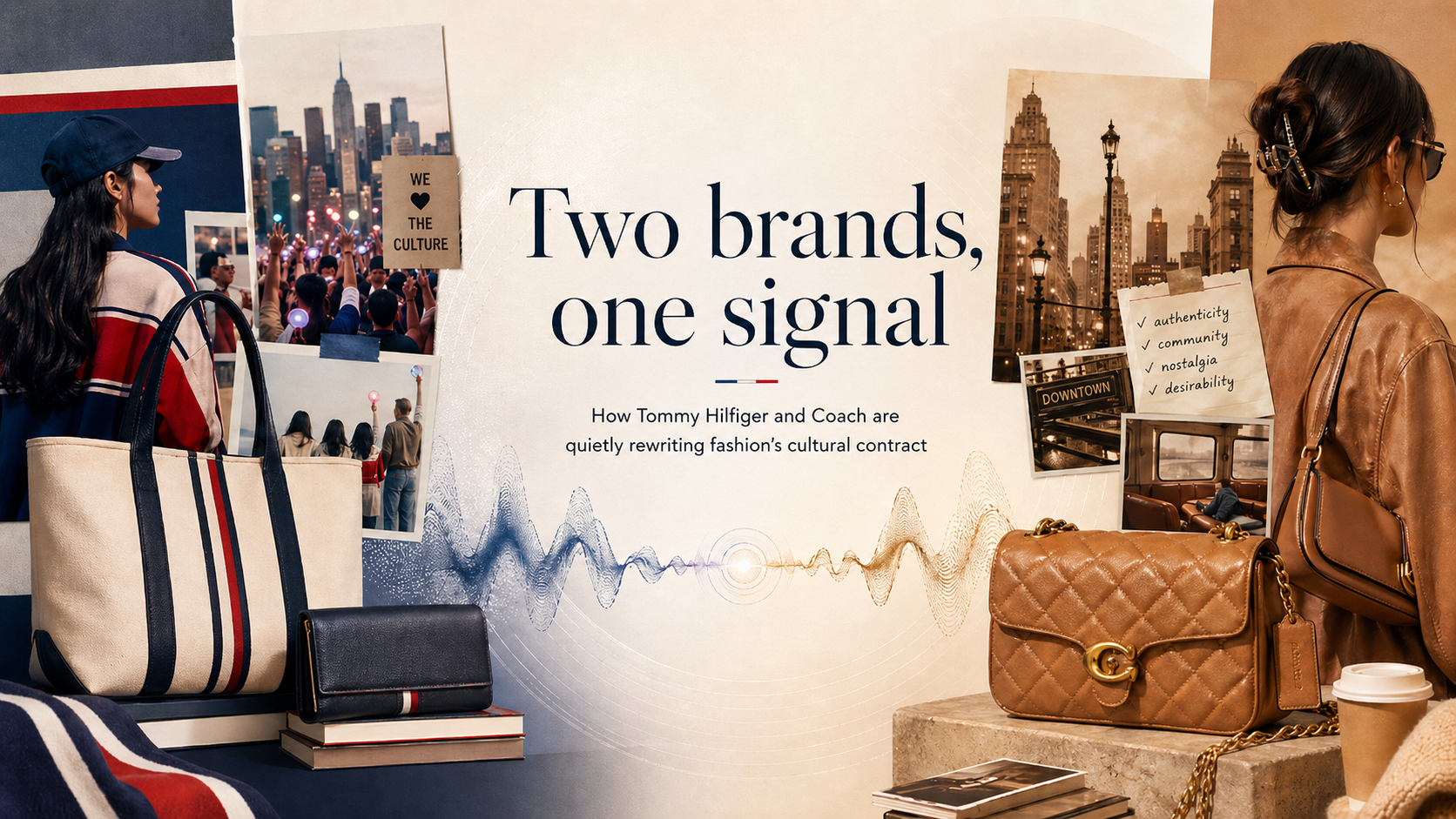
Two Brands, One Signal
How Tommy Hilfiger and Coach Are Quietly Rewriting Fashion’s Cultural Contract
By Adeleine Wang - Growth Marketing Strategist & Brand Observer
There are seasons in fashion when a brand stops merely selling clothes and starts selling a feeling: a sense of belonging, of being seen, of arriving somewhere worth being.
The years between 2025 and 2026 have offered two particularly striking examples of this alchemy: Tommy Hilfiger and Coach. Both are rooted in American heritage. Both speak to entirely different emotional registers. Both are succeeding in ways that feel less like campaigns and more like conversations.
Tommy Hilfiger: When Fandom Becomes Loyalty
The first time I noticed something shifting at Tommy Hilfiger was not in a press release or a runway recap. It was in the comment sections: the quiet, enthusiastic, almost tender way K-pop fans were documenting their visits to Tommy Hilfiger stores after Jisoo and Jang Wonyoung became associated with the brand.
To dismiss this as mere celebrity endorsement would be to misread the architecture of modern fandom entirely.
When a brand earns the trust of a K-pop idol’s fanbase, it is not simply borrowing star power. It is being granted access to one of the most emotionally invested, brand-loyal communities in contemporary consumer culture. Jisoo, with her particular grace and ability to carry classic American sportswear into a European editorial register, and Jang Wonyoung, whose every appearance is treated as a visual event by millions of dedicated followers, brought something to Tommy Hilfiger that no media budget can simply purchase: sincerity.
What followed was quietly fascinating to observe. Fans who had never considered the brand found themselves lingering in stores. The tote bags - practical, logo-forward, immediately recognisable - became objects of genuine desire. The classic long wallets, understated in their craftsmanship, found new audiences who initially came for the idol and stayed for the quality. The men’s wallets, designed with that particular Tommy sensibility of clean structure and collegiate ease, travelled through the fandom ecosystem as both gifts and personal acquisitions.
This is the beauty of a well-chosen cultural partnership: it does not force the brand into a demographic. It invites that demographic into the brand’s world. Tommy Hilfiger, to its credit, understood that the invitation needed to feel genuine, not transactional.
The brand narrative being built here is not simply “buy this product.” It is something more layered: this brand understands beauty, it understands craft, it understands the people you admire. That is a remarkably difficult message to construct through advertising alone, and a remarkably powerful one when it lands.
Coach: The Quiet Confidence of a Brand That Remembered Itself
Coach’s recent chapter is, in many ways, a lesson in the patience required for brand reclamation.
For a label that once occupied the aspirational sweet spot between accessible luxury and everyday elegance, the years of repositioning were not always graceful. But something changed, and Elle Fanning, as the face of a campaign that felt genuinely considered, was perhaps the clearest signal that Coach had found its editorial voice again.
Fanning brings a particular quality to everything she inhabits: a softness that is never weak, an ease that never reads as careless. In the Coach campaigns, she appeared not as a celebrity performing brand values but as someone who seemed to have simply arrived - as though the bags, the light, and the city behind her were all exactly where they were meant to be. For Gen Z audiences, attuned to authenticity and exhausted by performance, this distinction matters enormously.
But the campaign was only part of the story.
The Tabby bag, in its successive evolutions through 2025 and into 2026, became something of a quiet phenomenon. What the design team understood, and what many competitors still seem to miss, is that Y2K nostalgia is not simply about recreating the aesthetics of the early 2000s. It is about recapturing a particular emotional frequency: optimism wrapped in irony, femininity worn without apology, colour and hardware treated as a form of self-expression rather than restraint.
The Tabby achieved this with an almost deceptive lightness. The quilted texture, the distinctive turn-lock, the proportions that sit beautifully whether carried by hand or worn across the body: each of these elements speaks to a woman who dresses for herself, who has studied the archives and made her own selection. It is fashion as curation rather than consumption.
For female audiences navigating a market saturated with options, this felt like something rarer: a brand that was not trying to convince them of anything. It was simply offering something beautiful, and trusting them to recognise it.
A Closing Observation
What connects these two very different brand stories is something I find myself returning to often in my work: the most durable brand affinity is never manufactured. It is cultivated. It requires patience, cultural attunement, and a willingness to let the audience complete the story themselves.
Tommy Hilfiger let fandom become loyalty by choosing partners whose sincerity was beyond question.
Coach let a bag become a statement by understanding that nostalgia, when handled with genuine craft, becomes something entirely new.
Both remind us that fashion, at its most powerful, is never really about clothes.
Adeleine Wang is a growth marketing strategist and brand observer based in Taipei, with a focus on cross-border digital acquisition, SEO/AEO strategy, and cultural brand positioning. She writes at the intersection of data and narrative because the best brand stories are both.
| Portfolio |